
'/%3E%3C/svg%3E)
Bilayer nickelates have recently emerged as one of the most exciting new families of superconductors, offering fresh opportunities to understand the mechanisms behind high-temperature superconductivity. Yet, reproducing superconductivity in thin films has proven extremely challenging, with seemingly similar samples often exhibiting strikingly different electronic properties. Understanding the origin of these discrepancies is a crucial step toward the reliable design of superconducting nickelate devices.
Researchers at IPCMS (CNRS–Université de Strasbourg) and LPS (Paris-Saclay) have taken an important step toward answering this question by studying a new family of materials known as bilayer nickelates, which recently attracted worldwide attention after superconductivity was discovered in them.
Using state-of-the-art electron microscopy and spectroscopy, the team investigated how subtle changes in the atomic structure and oxygen content influence the superconducting properties of ultrathin La3Ni2O7-δ films. Although samples can appear nearly identical using conventional structural characterization techniques, the researchers revealed that tiny variations in the stacking of atomic layers and the distribution of oxygen atoms can determine whether superconductivity appears or disappears.
One of the study’s most significant findings is the identification of a particular crystal stacking sequence that does not support superconductivity. This discovery helps explain why superconductivity in bilayer nickelate thin films has been notoriously difficult to reproduce and highlights the importance of precisely controlling both crystal structure and oxygen stoichiometry during fabrication. Beyond solving a long-standing materials challenge, the work provides practical guidelines for producing more stable superconducting nickelate thin films operating at ambient pressure. These insights bring scientists one step closer to designing and engineering a new generation of oxide superconductors for future electronic technologies.
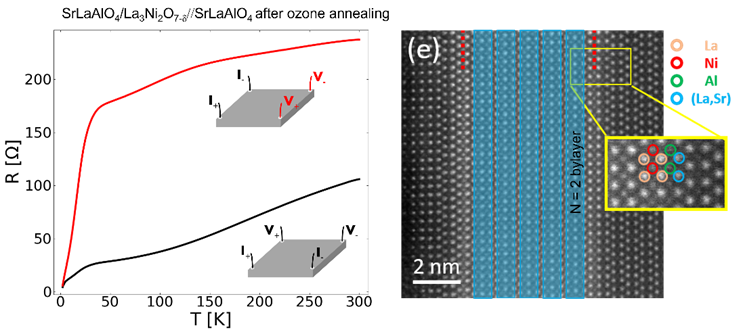
Reference : Flavenot Mathieu, Sahib Hoshang, Robert Jerome, Lenertz Marc, Versini Gilles, Schlur Laurent, Gloter Alexandre, Viart Nathalie, Preziosi Daniele, Decoding superconductivity in La3Ni2O7-d Thin Films via Ozone-Driven Structure and Oxidation Tuning, Small Structures 2026, 0, e70542. http://doi.org/10.1002/sstr.70542
Contact : Daniele.Preziosi@ipcms.unistra.fr
