

Quentin Rossi (IPCMS / DMONS)
Ces travaux ont été réalisés sous la direction de Matthieu BAILLEUL et de Daniel STOEFFLER.
Quentin Rossi (IPCMS / DMONS)
Ces travaux ont été réalisés sous la direction de Matthieu BAILLEUL et de Daniel STOEFFLER.
Quentin FENOY (IPCMS / DMONS
Ce travail a été réalisé sous la supervision d’Arnaud Gloppe
Un pot aura lieu à la cafétéria de l’IPCMS à l’issue de la soutenance, auquel vous êtes également conviés.
Ashfaque THONIKKADAVAN (IPCMS – DMONS)
Ce travail a été réalisé à l’IPCMS, sous la direction de Dr. Riccardo HERTEL.
La soutenance aura lieu le mercredi 12 novembre 2025 à 10h00, dans l’auditorium de l’IPCMS, et sera suivie d’une petite célébration à la cafétéria de l’IPCMS, à laquelle vous êtes chaleureusement invités.
Talha ZAFAR (IPCMS – DMONS)
Composition du jury :
M. Martin Bowen, CNRS, IPCMS, Strasbourg. Directeur de thèse
Mr. Pascal Turban Dr, Université de Rennes. Rapporteur
Mr. Oscar Cespedes Dr, Université de Leeds. Rapporteur
Mme Ilaria Bergenti Dr, Université di Bologna, Examinatrice
The program is available here.
Joël Bellessa (Institut Lumière Matière, CNRS-Université Lyon 1)
La proximité de nanostructures ou de films métalliques avec des semi-conducteurs affecte considérablement leurs propriétés, en particulier optiques. Nous décrirons, dans un premier temps, le couplage fort lumière-matière entre des semi-conducteurs organiques (molécules de type J-agrégat) et un mode de plasmon de surface. Nous discuterons en particulier des effets collectifs entre différentes molécules, induits par l’hybridation lumière-matière. En structurant le matériau à l’échelle de l’extension des modes cohérents, nous montrerons qu’il est possible de créer un type original de métasurface active polaritonique, ainsi qu’un transfert d’énergie efficace. Dans un deuxième temps, nous aborderons des structures comprenant des métaux et des semi-conducteurs inorganiques (arséniure de gallium). Les potentialités applicatives de ces structures pour la réalisation de lasers de surface seront décrites.
Ce travail a été réalisé sous la direction du Dr Jean-François Dayen. (IPCMS – DMONS)
Gyandeep PRADHAN (IPCMS – DMONS)
Composition du jury :
M. Edoardo Albisetti, Politecnico di Milano, Milan . Rapporteur
M. Matthieu Bailleul, CNRS IPCMS, Strasbourg . Directeur de thèse
M. Nicolas Bizière, CNRS CEMES, Toulouse . Rapporteur
M. Yves Henry, CNRS IPCMS, Strasbourg . Invité
Mme Liliana Prejbeanu, SPINTEC, UGA, Grenoble . Examinatrice
Mohamed SOLIMAN (IPCMS – DMONS)
Directeur de thèse : Jean-François Dayen,
Abhishake MONDAL (Solid State and Structural Chemistry Unit, Indian Institute of Science, Bangalore)
Abstract :
The pursuit of smart multifunctional materials with stimuli-responsive magnetic and optical response has drawn escalating interest in both fundamental science and potential applications to switches, sensors, and intelligent devices.1 One of the appealing feature of such materials is the tunability of their physical property via chemistry, where the linking structure and physical properties can be modulated in practically infinite ways, which gives them an edge over the solid-state magnetic materials (Figure 1, a).2 The field of molecular bistable systems is rapidly budding towards utilizing these molecule-based magnetic materials in physics-driven and nanotechnology-driven fields (Figure 1, b).
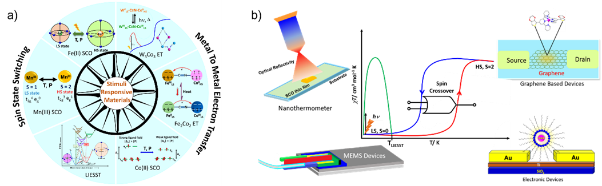
Figure 1: a) Stimuli-responsive molecular bistable systems and b) Application areas where these systems are actively studied for developing devices
Here, I will briefly cover the exciting field of Molecular Magnetism and will specifically focus on three most important aspects of Molecular Magnetism being pursued in my laboratory i) Spin Crossover (SCO) materials3 ii) Metal-to-Metal Electron Transfer Systems (MMET)4 and iii) Single Molecule Magnets (SMM).5 Lastly, I shall discuss the application of these bistable systems in developing ring-resonator devices for Photonics Application, molecular break junctions and microelectromechanical systems.
Acknowledgments: I thank the Indian Institute of Science (IISc), Bangalore, India, and the Ministry of Human Resource Development (MHRD), Ministry of Education (MoE), Government of India, IISc-Start-up Research Grant, the Department of Science and Technology, Mission on Nano Science and Technology (Nano Mission), Scheme for Transformational and Advanced Research in Sciences (STARS, MHRD), Council of Scientific and Industrial Research (CSIR) for the research fundings.
References:
1. Kamilya, S.; Dey, B.; Kaushik, K.; Shukla, S.; Mehta, S.; Mondal, A. Chem. Mater. 2024, 36, 4889, Kaushik, K.; Mehta, S.; Das, M.; Ghosh, S.; Kamilya, S.; Mondal, A., Chem. Commun., 2023, 59, 13107, Coronado, E., Nat. Rev. Mater. 2020, 5, 87. 2. Minguez Espallargas, G.; Coronado, E., Chem. Soc. Rev. 2018, 47, 533. 3. Ghosh, S.; Kamilya, S.; Pramanik, T.; Rouzieres, M.; Herchel, R.; Mehta, S.; Mondal, A., Inorg. Chem. 2020, 59, 13009, Ghosh, S.; Ghosh, S.; Kamilya, S.; Mandal, S.; Mehta, S.; Mondal, A., Inorg. Chem. 2022, 61, 17080, Bagchi, S.; Kamilya, S.; Mehta, S.; Mandal, S.; Bandyopadhyay, A.; Narayan, A.; Ghosh, S.; Mondal, A., Dalton Trans., 2023, 52, 11335, Ghosh, S.; Bagchi, S.; Kamilya, S.; Mehta, S.; Sarkar, D.; Herchel R.; Mondal, A., Dalton Trans., 2022, 51, 7681. 4. Kamilya, S.; Ghosh, S.; Li, Y.; Dechambenoit, P.; Rouzières, M.; Lescouëzec, R.; Mehta, S.; Mondal, A., Inorg. Chem., 2020, 59, 11879, Kamilya, S.; Ghosh, S.; Mehta, S.; Mondal, A., J. Phys. Chem. A 2021, 125, 4775. 5. Hossain, S. M.; Kamilya, S.; Ghosh, S.; Herchel, R.; Kiskin, M. A.; Mehta, S.; Mondal, A., Cryst. Growth Des. 2023, 23, 1656.